

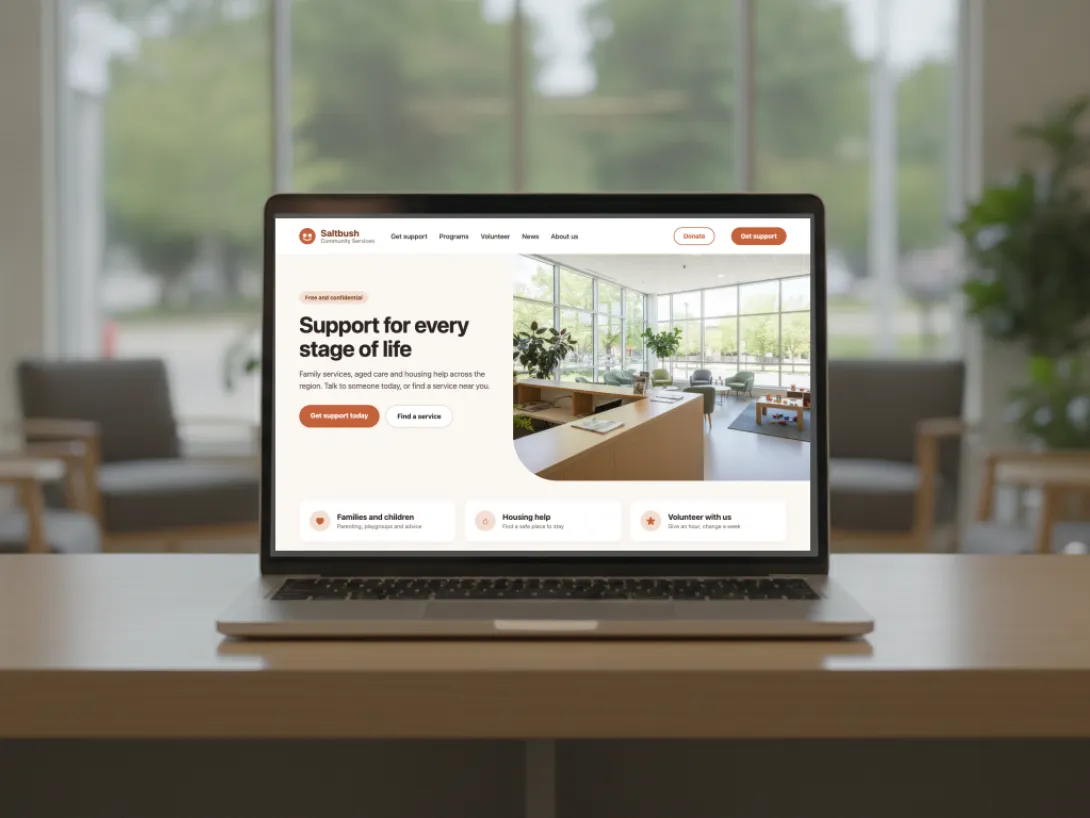
Does your website still fit the way your organisation works?
Most organisations start thinking about a new website when the current one stops keeping up. Maybe your team works around it every week, or a new service needs pages and forms the site was never built for. Sometimes the brand has moved on, or the technology underneath has reached the end of its life.
A new website is a big decision. The people who use it and the editors who keep it current both have to find it easy, and whoever looks after it in 3 years' time has to be able to work in it. It also has to arrive on a date and a budget someone has signed off.
Often part of what you need behaves like an application: a portal people log in to, a member area, a tool that works with your data, or rules about who can see and change what. Those parts need the same planning and testing as every page around them.
We plan, build and test your Drupal website as one team, from a straightforward marketing site to a web application or a group of related websites, so what launches is what you planned and every change after that is checked before it goes live. And if you have developers of your own, we can lead them through the work.
How we build your website
Every build follows the same 5 steps, and nothing starts until you've approved the scope and the cost.
1. We get to know your organisation and your current site
We start by listening: who the website is for, what it has to do and what your team finds hard today. If you have a site already, our free website health check gives us an outside view of it in a few minutes, and a site audit goes deeper when the new build depends on what's there. If the platform or the scope isn't settled yet, strategy work can come first.
2. We plan the website with you
Together we work out the architecture: the pages and content types, the components your editors will build pages from, the forms, who can see and change what, and the systems the site connects to, such as single sign-on, a CRM or search. If you need it, our brand and design work becomes the first phase of the build, and the same team builds what it designs.
3. We quote it, and you approve it
You get a fixed-price quote with the work grouped into parts you can read, along with the timeline, the milestones and the payment stages. You also choose how it's built: hand-crafted or AI-assisted, your choice. The AI-assisted path comes in up to 30% lower on suitable work, for the same tested quality, and where we offer it the quote shows both. A fixed-price quote is the price, and nothing starts until you've approved the scope and the cost.
4. We build and test it
We build in short stages you can follow, on Vortex, the open-source Drupal project template we created and maintain. Automated tests and a CI/CD pipeline, the process that builds, tests and deploys every change, run from the first commit. That means every change is checked before it reaches the live site, and this DevOps setup comes with every build.
Each week you get an email update on progress, the hours used and where the budget stands, and you can review working pages as they're built.
5. We launch it and hand it over
We move your content and data across, set up hosting and take the site live, and we're there through go-live. Your team gets the documentation it needs to run the site, and your editors get guidance on building pages and managing content. After launch, the same team can keep looking after it.
When your own developers do the building
Some organisations already have developers, in-house or through another supplier. What they're missing is someone senior to set the direction, hold the quality bar and check the work before it ships.
In a tech-lead engagement, your developers write the code and we lead them. For each feature, we:
- assess it and write it up as a ticket, with a user story, acceptance criteria and a solution direction your developers can work from
- set the architecture for the larger pieces of work, such as scaffolding a component library or redesigning how people log in
- review your developers' pull requests, over more than 1 round where the work needs it
- coordinate with your team on the larger features
It starts with a tech-lead assessment that sizes each feature and shows the hours and the cost, so you can decide what to go ahead with.
What you get
At launch, the website and everything needed to keep it going are yours.
A website that does what you planned
A Drupal website or web application with the pages, components, forms, permissions and integrations we agreed in the plan, with custom modules and a theme built to Drupal's coding standards.
A component library for your editors
Editors build pages from a set of components, such as banners, cards, forms and calls to action, so new pages match the rest of the site. The library is part of the front-end build.
Tests and a pipeline that stay with the site
The automated tests, written with tools such as PHPUnit, Behat and Cypress, and the pipeline that runs them are part of the code you receive. Changes made years after launch go through the same checks.
Your code and its documentation
The code lives in a repository you own, with documentation for your team and for whoever looks after the site in years to come.
Where we've done this
We've built and supported Drupal websites since 2016, for universities, government, community organisations and businesses. A few examples:
- We've worked alongside Victoria University's own web team on the university's websites since 2017.
- For a state emergency services agency, working through a global digital agency, we've led the Drupal engineering behind the public website people turn to during floods and storms since 2024.
- We helped build the foundations of the Victorian Government's Single Digital Presence, the system behind vic.gov.au and the agency websites around it.
We also build the tools we build with. Vortex(Opens in a new tab/window), our open-source Drupal project template, has been in continuous development since 2018, and every website we build runs on it. Our director was CivicTheme's founding technical lead from 2021 to 2025, and we build with CivicTheme, Salsa Digital's open-source Drupal design system, for organisations outside government too. You'll find the rest on our open source page, and more of our projects on our work page.
What it costs
Every website is quoted for its own scope. We talk through what you need, then send a fixed-price quote that shows how the price is built. A fixed-price quote is the price: if the agreed work takes longer than we planned, we carry it. Nothing starts until you've approved the scope and the cost.
On suitable work, the AI-assisted path comes in up to 30% lower. It goes through the same automated tests and reviews, with senior engineers making the decisions.
A tech-lead engagement is time and materials. The tech-lead assessment sizes each feature and estimates its hours and cost before any work starts, and the invoice reflects the hours actually worked. If it suits you better, the time can run as a prepaid block of hours.
Once your website is live, support and maintenance keeps Drupal and its modules up to date, security releases included, and covers the changes your team asks for. Hosting puts the infrastructure under it in the same hands. Both are priced on their own pages.
FAQs
Do you only build with Drupal?
Yes. We build and support Drupal websites, and our tooling, testing and support all centre on it. If Drupal isn't the right fit for what you need, we'll tell you early.
How long does a new website take?
It depends on the scope. Your quote sets out the timeline and the milestones alongside the price, and you see both before you approve anything.
Can you build from our designer's or agency's designs?
Yes. We often build from designs another team has created, and we work as the named technical partner for agencies. Our own brand and design work is there if you need it.
Will we be able to update the website ourselves?
Yes. Editors build and update pages from the component library, and we hand over guidance for your team at launch.
Who owns the code?
You do. The code lives in a repository you own, along with its tests and documentation, so any Drupal developer can pick it up.
Can you move our existing content across?
Yes. Content migration and data import are part of the build when you need them. If your current site runs on an older version of Drupal, our upgrade and migration service may be the better place to start, and a site audit will tell you which.
Do you build online stores, government websites and small business websites?
Yes, and each has its own page: ecommerce websites, government websites, including GovCMS, and small business websites. When the website needs to connect to your other systems, integration and automation covers it.